Wednesday, 16 June 2021

Blockorama Celebrates ‘Black is Love’ to Mark its 23rd Anniversary

By Neil Armstrong


Poster created by DJ Craig Dominic       Blockorama 23 'Black is Love' flyer promoting July 27, 2021 celebration


DJ first attended Blockorama in 2012 when he was 20, after coming out, and since then it has been an annual event that he attends with his mother and sister, and sometimes with friends.


“With Blockorama, it was just a place where I felt like all of my identities were acknowledged, in the sense that I’m a Black person and everyone around me is Black. My parents are of Caribbean descent, they’re playing the music that I listen to and know, the type of dance that I’m used to, for example, and I’m also a queer person. And, obviously, not everyone is queer but the majority of the people there are a part of the community.”


DJ says it will always be that place he looked forward to going because while there were many parties he could have attended on the closing day of the Pride Toronto Festival, he made a deliberate choice to be at Blockorama.


“That’s where I feel comfortable and I see friends and I see people in the community that I may not see all the time. And you also get to catch up with them and see how they’re doing and exchange numbers and reconnect sometimes.


“I am so thankful that it exists, to begin with, and I don’t see why I would ever stop going. I don’t think I’ve ever stop going, I always have so much joy and it’s safe too.  And you can be yourself. When you are there, you see the diaspora of so many types of queer Black people and however they like to represent themselves, whatever way it is, they’re there. And I don’t think people feel uncomfortable, you feel like you’re supposed to be there and you’re welcomed there and it’s a positive environment. “


DJ says the space also welcomes non-Black people who love Black music and appreciate Black culture. 


The Pride Parade is a family affair for him as he would usually go with his mother, with his sister or an aunt in tow, and one year he remembers his mother singing along to an artist who was onstage at Blocko and whose repertoire she knew very well from her younger years.


Blockorama is a celebration of and for the Black LGBTQ+ community and allies, organized by the collective, Blackness Yes!, and this year it is marking its 23rd anniversary.


Pride Toronto’s longest running and largest stage was born from the lack of representation for African, Black and Caribbean LGBTQ community members during Pride Toronto’s yearly festival, notes the website for Blockorama.


In 2020, like many event planners, the organizers had to host a virtual show because of the onset of the COVID-19 pandemic.


On Sunday, June 27, 6:00-9:00 p.m. it will again be virtual but with a difference from last year, notes DJ Craig Dominic.


“The virtual experience of Blocko last year was tough, not being in person and feeding off the energy. We at least had a virtual crowd that we could see and swipe through in the Zoom Room though. Seeing people experience Blocko from their homes, dancing and dressing up as they would in person was great and really helped us feel the vibe as organizers.” 


He says although there isn't a live audience component this year, “it's going to be an amazing show and people will get all of their Blocko life, definitely.”


“Pride has decided to pre-record all of the material and will assemble the show and broadcast it, so it's brought a different challenge. I will say, from everything I've seen, and I've seen it all, it's a better show than last year, though shorter. 


“We have more performers and they were able to be a lot more creative than performing in front of their webcams. I was able to me more creative with a pre-recorded set as well.”


Poster created by DJ Craig Dominic


Dominic is already thinking about the annual Blockobana happening on August 1 in Regent Park during Black Pride Weekend, July 31-August 1. He has been reaching out to various Black queer organizations across the province to find out their plans for that weekend so he can highlight their events in a schedule.


The late drag icon, Michelle Ross, was a popular performer at Blockorama and although she did not perform at the inaugural celebration, DJ Nik Red, another organizer, says Ross definitely did in most of the subsequent years. 


The image of Michelle Ross towers over the schedule of performers on the digital flyer created for the upcoming celebration by Dominic. Karimah Zakia Issa made kaleidoscope videos that will be featured in the show.


“She was one of the strong threads that held us together as we endured different locations in our continuous fight for respect. Michelle was for a lot of us the first drag performer that brought the Caribbean diaspora vibe and that really spoke to a lot of us. She also nurtured and encouraged numerous performers like Duchess and others.”


Like DJ Craig Dominic, Junior Harrison, one of the founders of Blockorama, was feeling the vibe of the event, dancing and “brucking a sweat to a soca set” last year in his living room. 


He says one year he got sick in June – which was a first for him – and he was homebound on Pride Day, usually the last Sunday in the month.


“It was the most surreal feeling I have ever had in my life but it also made you realize how we take things for granted.”


As a result, he is cherishing every Blocko and he loved the virtual experience of last year’s event. 


“I also thought, you know what, if at all possible this should be a standard for people who can’t make it to Blocko, for people who are not located in the GTA, people who are not located in Ontario, and people who are not located on this continent can participate in this thing.”


Harrison hopes that even when Blockorama goes back to the Wellesley St. parking lot in 2022 that the organizers will be able to live stream it.


The community stalwart says the show in 2020 was well done and he is hoping that this year’s event will have a tribute to Michelle Ross, Danger Kairo Kewusu, and others who have passed away since the start of the pandemic.


Reminiscing on when Blocko started in 1998, Harrison says at that time they did not set any expectations, in terms of who would show up and the numbers.


As the public relations lead, he would drive to various parts of the city to post flyers, even pasting them on the bus stop at Keele and Eglinton, and wondering if people were going to read them while he was standing there.


“There was no social media so it was word of mouth, email chain, going on some radio stations, CKLN and CHRY,” he says, and CKLN would eventually do remote broadcasts from the site.


Harrison recalls that on the day of the first Blockorama as they were setting up in the south end of the parking lot they figured that they had done as much as they could to get the word out.


“We’re here, if 10 people show up, if one person shows up we’ve done our job. Little did we know how quickly the grapevine happens and next thing you know there’s a crowd. There’s people just sort of happening upon the space, there’s people walking by, they see more than three Black people and they’re like what’s going on here. And then they’re the people who either got my little flyers out in the Toronto diaspora l call it. They would come and stay on the periphery, they wouldn’t come into the space but they would come and stay out on the Maitland [Street] sidewalk and peek in. And then as the day went on and as soon as the Parade wraps up around 3pm, 3:30pm/4pm., people were there. Grannies with their chairs and people with their small kids and we’re like okay, it’s happening in our little tent, one little tent, not even a stage and I think Duchess performed that day and a few others.”


Visual artist, poet and spoken word performer Courtnay McFarlane, another founding member of Blackness Yes!, has captured what Harrison just recalled in one of his poems about Blocko.


In a special issue on Queer Canada of the Journal of Canadian Studies, Vol. 54, No. 2-3, Spring-Fall 2020, Christopher Smith, in their article titled “Where u from, who u wit?!” Black Pride Festivals as Itinerant Hospitality underscores the significance of Blockorama at the Pride Toronto Festival.

“Through the curatorial imperatives of the programming body Blackness Yes, Blockorama would provide a site for the front-line dissemination of HIV prevention and sexual health literature, but it would also offer a soundtrack and space that recognized the diversity of tastes and regions across the Black/African diaspora. When an individual exited Wellesley subway station, their senses were awakened by the rhythms of various Black popular musical forms and the aromas of Caribbean cuisine. Through sensory modes of address, Blockorama would signal that it was a site for pleasure and sustenance and that one need not feel lost in the larger festivities—that, in fact, there was a “home-place” where Black LGBT+ individuals could arrive at Pride as their fully embodied selves,” writes Smith. 

Smith received their doctoral degree from the Department of Social Justice Education at the Ontario Institute for Studies in Education and the University of Toronto. Their dissertation “Apprehending Black Queer Diasporas: A Study of Black Pride Festivals and Their Emplacements” is based on a multi-site research project that examines the origins of Black LGBT+-centred festivals. 

Blackness Yes! is a volunteer collective made up of professional DJs, stage and visual artists, community organizers, healthcare practitioners and activists. Since its inception, it has built and sustained safe spaces for African, Black and Caribbean (ABC) LGBTQ communities through art, music, AIDS awareness and outreach.


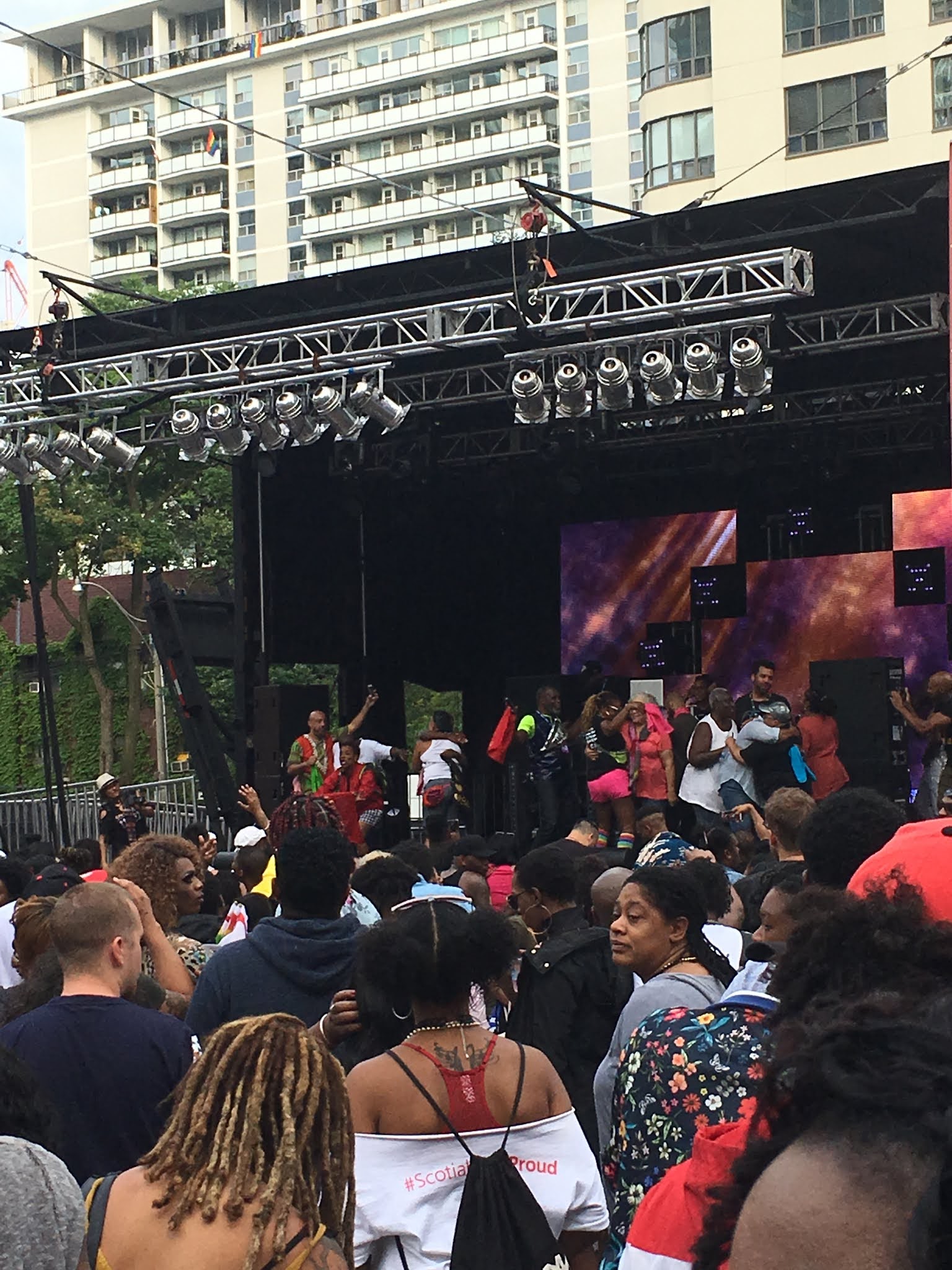
Blockorama at Wellesley parking lot on the last day of the Pride Toronto Festival

Blockorama

Blockorama


A SELECTION OF STORIES FROM THE PAST (2012 – 2018)


Syrus Marcus Ware, curator of “The Fire This Time: Blockorama Retrospective Exhibition” at Glad Day Bookshop on June 22, 2012 during Pride Week.

Featuring work by: Christopher Cushman, Abdi Osman, Courtnay McFarlane, JORIAL, Kamille Grant, Deviant Productions, Syrus Marcus Ware and more.


“Toronto has an incredible history of African Diasporic LGBTTIQQ organizing and activism. It also has a thriving artistic community and a burgeoning queer arts scene. It is from within this history and community that Blackness Yes! has created The Fire This Time: A Look Back at the Blocko, a retrospective exhibition that considers the many artworks created through 14 years of Blockorama, a day-long festival celebrating black LGBTTIQQ community in Toronto,” notes a synopsis of the exhibition.


Photo credit: David Lewis-Peart.  Left to right: Tawiah Ben McCarthy, Daniel Ellis, Samson Brown and Thomas Olajide in "Picasso's Black Canvas"


Picasso’s Black Canvas with actors: Tawiah Ben McCarthy, Daniel Ellis, Samson Brown and Thomas Olajide at Buddies in Bad Times Theatre on June 27, 2012.


“Young, G(ay)ifted & Black: (Re)Telling The Stories Of Survival and Thrival for Young Black Men” – Picasso’s Black Canvas -- is a collaborative effort between Black Coalition for AIDS Prevention (Black CAP), Project Humanity, CIHR & Buddies to share key outcomes from Black CAP’s modified Many Men, Many Voices Intervention (3MV) bringing new insight, understanding and reflection of lived experiences of Young Black Men who have Sex with Men (YBMSM) to the community at large. 


From January 17 to February 1, 2015, Small Axe, co-produced by Project: Humanity and The Theatre Centre. On January 18, 2015, Black CAP, Project Humanity and Dwayne’s House presented “Small Axe: In Solidarity,” a fundraiser to support work with Jamaican LGBT communities (Dwayne’s House) at The Theatre Centre. A community dialogue on homophobia, migration and Black communities took place following the performances.


A queer white documentary theatre-maker thinks he’s investigating homophobia in Jamaica. But what starts as a quest to expose an injustice, turns into a burning call for his own personal transformation.

How do we justly engage with an injustice? To whom does an injustice “belong”? Through a constellation of encounters — with activists, refugees, priests and ministers, journalists, artists, Pride Week revelers, and many queer people of colour – Small Axe asks us to bravely face our differences in order to discover how intricately connected we are.

Created by playwright/performer Andrew Kushnir, director Alan Dilworth, and Project: Humanity.


KasheDance presented “Facing Home: Love and Redemption” at the Aki Studio in Daniels Spectrum in 2015.


“Facing Home: Love and Redemption” is a contemporary dance production that investigates the global impact of Bob Marley’s music – its expression of humanity’s struggle and its inspiration toward love , redemption and hope – and the active, deep-rooted homophobia in Jamaican/West Indian culture.


Black Boys, created by the Saga Collectif and featuring Thomas Olajide, Tawiah Ben McCarthy, Stephen Jackman-Torkoff returned to Buddies in Bad Times Theatre in 2018 after premiering in 2016. On November 30, 2016, a performance of the play was held as a fundraiser for Black CAP.


A raw, intimate, and timely exploration of queer male Blackness, Black Boys is created from the lives of three people seeking a deeper understanding of themselves, of each other, and of how they encounter the world. As they explore their unique identities on stage, they subvert the ways in which gender, sexuality, and race are performed. Theatrical and intimate, Black Boys weaves together the ensemble’s own personal stories in search of an integrated self and a radical imagination.


The poster for "speaking of sneaking," a theatrical piece created by dancel jelani ellis


In May 2018, emerging artist daniel jelani ellis presented a new theatre piece, speaking of sneaking, as part of Why Not Theatre’s The RISER Project at The Theatre Centre.


speaking of sneaking is a contemporary, cultural remix of two traditions; the archetypal Jamaican ginnal and the mythical African Anansi. For the premiere of this new show, working with director di’b.young anitafrika and choreographer brian solomon, ellis was inspired by the experiences of growing up queer in Jamaica and finding home in Canada.  He is interested in investigating the complex relationship between immigration and displacement, yard and foreign, home and abroad.  


RESOURCES & EVENTS


Black Gay Men’s Network of Ontario (BGMN)

The Black Gay Men’s Network of Ontario is a centralized hub for same-gender-loving men of African, African diaspora, Afro-Latino, Caribbean and Black identities, operating from Toronto as an independent and autonomous entity.

Our goal is to provide cultural, intergenerational and mentorship opportunities, leadership, self-development and empowerment as well as activism support aimed at improving the lives of Black queer people in Ontario.


Pride Events 2021 - “Sweetness fuh Pride,” (June 20, 5:00-6:30 p.m.)

“Dine and Lime,” (June 25, 7:00-10:00 p.m.)

Check BGMN’s social media platforms for more information.


Black Coalition for AIDS Prevention (Black CAP)

Since 1989, the Black Coalition for AIDS Prevention (Black CAP) has worked to respond to the threat of HIV and AIDS in Toronto’s African, Caribbean and Black communities. Our work is guided by our motto, ‘Because All Black People’s Lives Are Important’, which serves as a reminder of our commitment to the human rights and dignity of all Black people who are vulnerable to HIV and sexually transmitted infections (STIs). 


Pride events 2021 – Community Lyme, Pride Edition on Saturday, June 19, 7:00-9:00 p.m. 

Check Black CAP’s Facebook page for more information on this and other events.


Bigger Than We

Bigger Than We (BTW) is a Toronto-based collective of Black LGBTQ+ artists and community activists dedicated to using various artistic forms to develop intergenerational creative experiences for members of Toronto’s Black LGBTQ+ communities with the goal of strengthening the fabric of our communities by building intergenerational bonds of understanding, friendship and solidarity.

Bigger Than We 2 will happen during the fall as a hybrid (online/in-person) one-day event, with careful consideration given to adhering to COVID-19 protocols.


There was a call for a total of 20 community participants to contribute to the design and creation of one of three integral activities for the one-day event.
  

Activities and Lead Artists
Opening ceremony performance (Sedina Fiati / David Lewis-Peart)
Interactive historical timeline (Courtnay McFarlane / Jonathan Broderick)
Collective story creation (Chiedza Pasipanodya / Taymah Armatrading)

Check Facebook page for more information.


Salon Noir

Salon Noir is born out of our desire and commitment to black trans, gender fluid, gender queer and queer people to provide a safe place for our communities to laugh, learn, love and socialize. 


Keeping it 100

Keeping it 100, or K1 for short, is a Black guy into guys peer discussion group. To participate, email Robert at r.alsberry@maxottawa.ca for ZOOM link. You can also contact MAX via email, phone, or social media and MAX can give you more details.


Max Ottawa

MAX is a community-based organization that focuses on maximising the health and wellness of gay, bisexual, Two-spirit, queer, and other guys who are into guys, both cis and trans in the Ottawa region.


Black Queer Youth

Black Queer Youth (BQY) is a weekly drop-in group where we celebrate Black queer and trans spectrum people’s experiences and accomplishments. It is a space dedicated to your creativity and desires. It is a safer space for you express your whole self. BQY is administered by Supporting Our Youth (SOY), an innovative community development program of Sherbourne Health.


Black Queer Youth Collective

Provides opportunities and support to Black LGBTQ+ youth in Toronto, Ontario since 2017.


The 519

The 519 is committed to the health, happiness and full participation of the LGBTQ2S communities. A City of Toronto agency with an innovative model of Service, Space and Leadership, we strive to make a real difference in people’s lives, while working to promote inclusion, understanding and respect.


Wednesday, 9 June 2021

African Canadians Welcome the Dismissal of a Complaint Against Justice Donald McLeod


By Neil Armstrong


Photo credit: Clive Sewell     Justice Donald McLeod speaking at the National Black Canadians Summit at the Toronto Reference Library where the Federation of Black Canadians was launched in December 2017


Overjoyed.


That is the feeling of many African Canadians  -- who were following the Ontario Judicial Council hearing into four allegations of misconduct against Justice Donald McLeod -- when they heard that the complaint against him was dismissed. 


McLeod, a judge in Brampton, Ontario was facing allegations of perjury and judicial misconduct, which if there were a finding, could have resulted with him losing his job with the Ontario Court of Justice.


On June 2, the Ontario Judicial Council released the 242-page decision of the hearing panel which examined a complaint about the conduct of Justice McLeod, the only Black judge at the Ontario Court of Justice in Peel. As a result of the allegations, Justice McLeod has been off the bench for over two years.

The complaint alleged that on December 20, 2018, a hearing panel of the council dismissed a complaint against the judge regarding “his involvement in, and leadership of, an organization called the Federation of Black Canadians (“FBC”), a national, non-profit organization that meets with government representatives to advocate for legal and social reform on behalf of Black Canadians.”

It alleged that at the previous hearing, McLeod “committed perjury and/or mislead the Hearing Panel regarding his involvement in FBC’s advocacy efforts in a deportation matter. He also misled the Hearing Panel about his disengagement from FBC after concerns were raised about his involvement.”

According to the allegation, following the decision of the hearing panel, Justice McLeod resumed a leadership role in the FBC and attended political events on its behalf. “He engaged in behaviour that was or could be perceived to be impermissible advocacy and lobbying by a sitting judge.”

The complaint also alleged that he engaged in behaviour “that was or could be perceived as providing legal advice and/or furthering the advocacy of the FBC by counselling two individuals not to speak publicly about an alleged racist incident that occurred at the National Black Canadians Summit in February 2019.”

In its dismissal of the complaint, the four-member hearing panel led by Justice Janet Simmons of the Court of Appeal for Ontario found that the first and second allegations were not made out. 

“Further, although we find that aspects of Justice McLeod’s conduct involved in the Third and Fourth Allegations were incompatible with judicial office, we conclude that such conduct did not rise to the level of undermining the public’s confidence in his ability to perform the duties of his office or the administration of justice generally. Accordingly, such conduct does not amount to judicial misconduct.”

“Given that the complaint has been dismissed, a recommendation that Justice McLeod be compensated for his costs for legal services is mandatory. 

‘The First Panel noted that this question has been considered by way of written submissions in the past. We therefore ask that Justice McLeod’s counsel provide submissions on compensation and a costs outline 14 days following the release of these reasons. Presenting Counsel may file any response within 14 days thereafter.”

The panel noted that the OJC Registrar is directed to update the Council’s website to reflect the amount of compensation requested and the amount ultimately recommended. “The submissions, costs outline and our written recommendation to the Attorney General shall be part of the publicly accessible file.”

African Canadians who know McLeod and his work in the Black community mentoring youth and lawyers are glad that the outcome of the hearing vindicates him.

“This is GREAT news indeed, especially during a COVID-19 year when many have been faced with various challenging and tragic circumstances.  Justice Donald McLeod is beloved and well-respected in the community and across the GTA/Diaspora,” says Marjorie Taylor, the 2015 Brampton Citizen of the Year.


She says he is considered a role model in the Black community and was honoured with a Black History Month Community Leadership Award in 2019 by Peel United Cultural Partners, a partnership of the United Achievers' Club of Brampton and Congress of Black Women of Canada - Brampton Chapter, in 2019.  


“His character has always shone through and his dedicated service to his community and to enhancing the lives of all, but particularly those of Black/African/Caribbean heritage, have not gone unnoticed.  This is a great vindication and endorsement of the high esteem in which Justice McLeod is held.  It would have been a great loss to the judicial system had the result been otherwise.”  


Adaoma Patterson, president of the Jamaican Canadian Association, says the JCA is pleased and relieved to hear that the complaint against Justice McLeod has been dismissed.


“We are of the opinion that it is the right decision and serves to remind us that the legal system must account for and consider the social conditions that exist in the world. Diversity in all its forms is essential to a more just legal system. The JCA looks forward to seeing Justice McLeod back in the courtroom where he belongs.”


Meanwhile, Ainsworth Morgan, a friend of the judge for about 20 years, says he is happy for him on many levels.


“I’m happy for Donald and his family to sort of be able to resume their lives. He has been on hold for over two years of not being able to be on the bench and so I’m really happy for him on that level. I know it’s not been easy for him or his family so just glad that that chapter is over with.”


Morgan says he is hoping that what comes out of this are reflection and healing because it is unfortunate that it had to reach this situation.


“I am beyond elated. I think the only way to describe the filing of the complaint against Justice McLeod is as a failed witch hunt that got started simply because some people hate the skin they are in,” says Kathy McDonald, a trustee of the Peel District School Board and an active community member of Peel.


“Our community will never make inroads unless we stop this crabs-in-a-barrel mentality. There is room for all kind of advocacy. We need people in the streets in jeans shouting and rattling cages but we also need people in $1000 suits (or bargain basement outfits) in courtrooms and boardrooms. Our community needs to address the elephant in the room and learn from this horrible experience. In the end, the only people that were hurt by this failed vendetta were the Black children and residents of Peel that were denied the dignity of having an excellent judge in Donald McLeod to preside over their trial.” 


The hearing panel consisted of Justice Janet Simmons of the Court of Appeal for Ontario, as chair; Justice Michael J. Epstein of the Ontario Court of Justice; lawyer member Malcolm M. Mercer; and community member Victor Royce.

 The presenting counsel was Borden Ladner Gervais LLP: Guy J. Pratte, Nadia Effendi, Christine Muir, Veronica Sjolin, Mannu Chowdhury.

 The counsel for Justice McLeod was Torys LLP: Sheila R. Block, Irfan Kara, R. Craig Gilchrist; Addario Law Group LLP: Frank Addario, Wes Dutcher-Walls; Mirza Kwok | Criminal Defence Lawyers: Faisal Mirza; Gates Criminal Law: Kelly Gates

The hearing panel noted that the “current complaint was premised on a blog published by Desmond Cole in late February 2019. Among other things, the blog referred to Justice McLeod resuming his involvement with the FBC; the FBC’s continuing involvement in coordinating meetings with and presenting “asks” to the government; Justice McLeod’s attendance at a meeting on January 13, 2018 with Ahmed Hussen, then-Minister of Citizenship, Immigration and Refugees (“Minister Hussen”[1]), allegedly to discuss the Abdi case; and Justice McLeod counselling youth delegates about whether to speak about a racial profiling incident that occurred at the 2019 Summit.” Abdoulkader Abdi, a Somali refugee, was the subject of pending deportation proceedings.

The evidence in the matter consisted of the oral testimony of 13 witnesses and 22 numbered exhibits. Overall, the panel heard 15 days of evidence in December 2020 and February 2021. Following the evidence, the panel heard two days of oral submissions in March 2021. The review panel subsequently received written submissions totalling over 400 pages in April 2021.

“We have concluded that two aspects of Justice McLeod’s conduct were incompatible with judicial office but not so seriously contrary to the impartiality, integrity and independence of the judiciary that, whether considered individually or cumulatively, they rose to the level of undermining the public’s confidence in his ability to perform the duties of his office or the administration of justice generally. We therefore dismiss the Current Complaint,” said the members of the hearing panel. 

The review panel noted that the, “2020 Notice of Hearing was filed not long before the onslaught of the pandemic. No doubt this created extraordinary challenges for all counsel in preparing and presenting this case. We were impressed by the roles played by “less senior” counsel in not only preparing, but also presenting, it. We are grateful to all counsel for their diligence and professionalism in assisting us.”


On December 29, 2020, community members held a virtual Black Community Healing Circle, noting that, “recognizing the pain and hurt of the Donald McLeod hearing on the community, this space is being created for us to share how we are being affected, support each other and begin the healing process.”

Justice for Justice McLeod, made up of “members of the Black community who believe in the notion of love in the face of hardship and adversity,” says the judge has been vindicated.

‘We believe in the strength of our power and we believe that an attack on one of us is an attack on all of us,” notes the group’s Facebook page.

On its Twitter page, it declared, “Justice has prevailed. The voices of our communities have prevailed. Anti-Blackness will not silence a Black Judge nor make him lose his job. Justice McLeod has been vindicated!”

 Justice McLeod was appointed as an Ontario Court of Justice (OJC) judge on September 18, 2013. Since his appointment, he has presided in Brampton in the Central West region. 


The hearing panel notes that, “Before being appointed to the bench, Justice McLeod had a successful career, practising criminal and administrative law. He was also active in the community, focusing in large measure on organizations that mentor Black youth. Having overcome the barriers created by poverty and racism, Justice McLeod feels a strong obligation to “pay it forward”.”


In 2019, Justice McLeod was among several Canadians recognized as the World’s Most Influential People of African Descent, in support of the United Nations International Decade for People of African Descent.

As a special edition honoree, he was celebrated for his contribution to law and justice.

Among those named as part of the 2019 cohort of the 100 Most Influential People of African Descent (MIPAD) Under 40 were: Abel Makkonen “The Weeknd” Tesfaye and 2019 NBA Champions; Toronto Raptors and Masai Ujiri, president of the Toronto Raptors (for media and culture); Dahabo Ahmed Omer, co-founder, Justice for Abdirahman, stakeholder lead, Federation of Black Canadians, and operations director of the Somali Center for Family Services; Marlihan Lopez, vice president of Fédération des femmes du Québec (Quebec Women’s Federation); and Sandy Hudson, co-founder of Black Lives Matter TO (for humanitarian, activism and religious).

The MIPAD ceremony was in New York, following the opening of the 74th UN General Assembly in September that year.


Saturday, 22 May 2021

School Officially Renamed Hodan Nalayeh Secondary School

By Neil Armstrong


Photo contributed     Somali-Canadian journalist Hodan Nalayeh in whose honour a school in Vaughan, Ontario was renamed Hodan Nalayeh Secondary School


Students at Hodan Nalayeh Secondary School in Thornhill, Ontario, are brimming with ideas about how to celebrate the former Somali-Canadian journalist in whose honour their school was officially renamed on May 19.


Some have suggested including daily quotes from her during the school’s morning announcements, at annual assemblies, and on social media. Others believe that she was a model of inspiration, social activism and education and they want her story told at the school so that all students know it. 


Nalayeh, who once resided in Vaughan, and her husband, Farid Jama Suleiman, were among 26 people who were killed in an attack on the Asasey hotel in Kismayo, Somalia, on July 12, 2019. 

The renaming ceremony follows a meeting of the York Region District School Board (YRDSB) in early March at which a motion to change the name of Vaughan Secondary School was voted on with 10 of the 12 trustees in favour of it. This change resulted from a major push by the Black community to have it done.

The school’s previous name honoured Benjamin Vaughan, a Jamaica-born British diplomat who stood up in the British Parliament in 1792 and argued that freeing enslaved Africans in Jamaica would bring about the end of civilization. 

Cynthia Cordova, chair of the YRDSB, recognized the many members of “our Black community who brought the issue of the naming of this school and the effect that it has had on our students to the attention of trustees and staff.”


“We are grateful for your work to initiate the renaming process and for your advocacy on behalf of the Black students in York Region. It is our hope that the new name will better reflect the identity, the accomplishment, and the aspiration of students at Hodan Nalayeh Secondary School.”


Cordova said many students were involved in the renaming process of the school.


“We heard from many students through their letters, their emails, their posts on social media and the opinions that were shared during the town hall. We are very proud of the way our students shared their voices and we’d like to thank everyone who participated in this process.”


She said all students and staff should feel safe and supported in learning and working environments that are inclusive and identity affirming, and honour and celebrate their identity. 


“That is what I think of when I think of Hodan Nalayeh, someone who worked to create safe and identity affirming environments. Hodan was an accomplished young woman, a mother, a resident of Vaughan and she worked to empower and give voice to women, youth and members of the Somali community. It is only fitting then that the first school in York Region District School Board to be named after a Black Muslim woman should be named after Hodan Nalayeh. It is our hopes that when students arrive each day to school and see Hodan’s name that they are reminded of who Hodan was and what she stood for, and they know that they themselves are valued for who they are at Hodan Nalayeh Secondary School.”


Born in Las Anod, Somalia, in 1976, Nalayeh, who had four brothers and seven sisters, and her parents, migrated to Canada in 1984, first settling in Edmonton, Alberta before eventually moving to Toronto in 1992. 

She attended West Humber Collegiate Institute and then pursued post-secondary education at the University of Windsor where she received a Bachelor of Arts in communications. Nalayeh also earned a postgraduate certificate in broadcast journalism from Seneca College.


Louise Sirisko, director of education, said they heard very clearly that the school needed to be renamed. 


“We heard that the previous name caused hurt and harm to students, staff and members of the broader community, especially the Black community. “


Sirisko said there were many community members who came forward to tell the board that the name did not make them feel safe, valued and included.


In providing a context for the unnaming and renaming of the school, Cecil Roach, coordinating superintendent of Indigenous education and equity, said the

 work to develop the Anti-Black Racism Strategy coincided with the effort to rename Vaughan Secondary School .


“Benjamin Vaughan was an owner of enslaved Africans. Not only did he own enslaved Africans, he passionately argued against ending the inhumane system of slavery because according to him it would mean the end of civilization in Jamaica as he knew it. This actually mean that he saw people of African heritage as fundamentally uncivilized and whose very humanity he questioned.”


Roach said that the renaming effort was largely championed by York Region’s Black community and its allies and that the campaign was led by the former Vaughan African Canadian Association, now called ANCHOR, and its tireless leader, Shernett Martin. 


After discovering that the school was named after a slaveholder, Martin embarked on a campaign to have it addressed.


“We owe a debt of gratitude to Shernett and we thank her for her efforts that played such a major role in getting us to where we are today – renaming the school after a Black Muslim Somali woman, a Black Somali woman who represents many of the things that the Dismantling Anti-Black Racism Strategy is hoping to achieve. Hodan was a social activist more than a media personality. She, actually, was the kind of woman who believed in raising the voices of Somali Canadians and changing the narrative, the negative narrative, in many cases of Somalis.


Roach said he once heard Nalayeh deliver a keynote speech at an event where women who were survivors of domestic violence were celebrated. Her message was one of telling women to rely on their inner strength and know that the world is at their fingertips, that they can achieve whatever they want to achieve once they work at it.


“One of the priorities of the Dismantling Anti-Black Racism Strategy is a commitment to bold leadership and Hodan Nalayeh certainly embodied this notion, he said.


Roach said the aim of the Anti-Black Racism Strategy is to ensure that Black students have educational journeys that celebrate and affirm their identity, just like Hodan wanted Canadians, the public and the world to understand that Somali Canadians, Somali people, generally, are people who should be celebrated. 


He congratulated the Black community and the school trustees for taking the bold decision to name the school after a Somali Black Muslim woman.


Sahra Nalayeh said her sister was someone who loved to have fun, loved music and writing. 


“Hodan was a passionate person, she was a person who thought about other people, the experiences they were having, what was happening in their lives, and most of all, how she could support them and tell their story. She loved to tell stories about the human condition. Specifically, when she returned to Canada one of the things she really noticed was there was a lack of stories in the media about the Somali community, the Black community and she wanted to make sure that she had a chance to correct the stories that she was hearing,” Sahra said describing her sister as a humanitarian. She was a mother of two young sons.


“As a journalist, she saw a way that she can contribute to the world, to society to make a difference and she followed her passion and that led her to starting her own media company, her own YouTube channel.”


Shernett Martin said the renaming is a celebration of what it means when “a couple of people believe in something, fight for somrthing, and collectively lean on each other and lean into each other and believe in what they’re doing and then see the fruits of that labour.”


“It was an exercise in fighting for your humanity and your civil rights. It felt like we were in a moment in the past where we were fighting to do something really important.


“And so as a Black woman for me to see another Black woman’s name on a school is extremely fulfilling. The fact that that legacy now is on that building and inside that school it means a great deal – I think it’s going to be the first of many. I think for young Black girls and young Black boys to enter that building and for any equity seeking group to know that this just wasn’t something that was easily done, there was a real push from community behind this. I think it empowers young people to say whether its climate change or fighting against issues that they believe in that you can change the system, you can move the needle.”


Martin said it gives that feeling that they can do it, “they can come together over an issue and fight until they win because that’s exactly what we did.”


Sahra and her father, Ahmed Said, unveiled a portrait of Hodan that will be displayed at the school.