Friday, 12 May 2023

Ronald Taylor Dance Celebrates 30th anniversary with ‘Psychosis’

 By Neil Armstrong


Photo credit: Michael Mortley of M.M. Adjust Your Focus       Artistic director and choreographer Ronald A. Taylor


Artistic director and choreographer Ronald A. Taylor has turned his lived experience and investigation of mental health illness of Caribbean people living in Canada into a production, “Psychosis,” that will be showcased at the 30th anniversary celebration of his company, Ronald Taylor Dance, later this month.

The deeply personal work, which is of an interdisciplinary nature, was workshopped in 2019 as the first and only dance entrant in the history of the Rendezvous with Madness Festival presented by Workman Arts and considered the first and largest arts and mental health festival in the world. 

“I experienced my psychosis which totally sort of eradicated my family life. Even though we’re close, I’m not with my family at anymore,” says Taylor, noting that this happened when he turned 48 years old. “It just turned my life upside down but I have to say within the journey of it that I had angels—case workers, psychiatrists, and what not in my aid to my recovery.”

In the throes of his psychosis, Taylor says he remembers being in a halfway house in Newmarket, Ontario, and “the sun coming over the roof of the house and I was standing on a bank, and that was my aha moment that I said to myself, Ronald Taylor, you’re not well.”  He didn’t know where to turn but felt that he was on his way to recovery and ended up at Mount Sinai Hospital where he was diagnosed as having psychosis by two health practitioners.  

Taylor said Dr. Adrian John Grek was the head psychiatrist at the hospital and took him on as a patient allowing him to express himself and examine his life through a series of questions. This gave the artistic director a holistic view of himself. “I was able to answer questions and sort of put my life into somewhat as close a semblance as when I was a sane person.”

The dancer also decided to look at the people from his childhood who society deemed as mad and “sort of pushed them in a corner” not understanding the mechanisms of psychosis, schizophrenia, and other issues related to mental health.

“The production is stories within a bigger story and it ends in a celebration because I believe life is a celebration. So the vignettes that you will get or the stories that you will get are of individuals who I observed as a child and even into my adult life who have gone through psychosis.”

Taylor notes that the Caribbean community does not deal with these types of matters in a favourable manner. 

“In the production, is me also holding up a mirror to our community to say, hey, you know, we all have a degree of psychosis or mental illness but some of us manifest it and some of us don’t.  Some of us get help before it happens and some of us don’t,” says Taylor, noting that he tries to encompass everything under one umbrella by highlighting the various headlines within psychosis.  

Describing it as a very complex work, Taylor says there are many things happening on stage “that will draw your attention and pull your attention” to show how complicated life is “but at the end how joyous life can be.”

Taylor, who was born in Trinidad and trained at The Juilliard School in New York, a conservatory that is a world leader in performing arts education, says dance has always played an important part in his life.

As the eldest of three adopted children growing up with his godmother, he remembers the Prime Minister’s Best Village Trophy Competition created by the country’s first prime minister Dr. Eric Williams who decided to counter the predominance of European culture by instituting the competition which brought folk culture, life, and the history of the twin-island republic to the fore.  

Taylor says his family was very talented but being the second to last child he had to find his own pathway to the performing arts. He attended classes and went to the neraby community centre where his friends encouraged him to come and dance.  

From the age of 17 to 48, he danced on many stages around the world—a fulfillment of his godmother’s advice to always make something of himself. “She didn’t say what but I chose dance as my way of making a contribution to humanity, of my way of moving forward, of my way of being a good citizen.”

Taylor doesn’t dance anymore but he is still at the helm of the company presenting work in which Caribbean people can see themselves and even question themselves about their lives and hope to become better citizens of the world.

He has put together a dynamic and experienced cast of eight performers, including dancers, musicians, and actors, to present this very important work in Toronto at the Native Earth’s Aki Studio, located at Daniel Spectrum on Friday May 26, and Saturday May 27, 2023, at 8pm. 

As founder and artistic director, Taylor is no newcomer to the dance scene. Since its inception in 1993, Ronald Taylor Dance (formerly known as Canboulay Dance Theatre) has created over 20 works, including a full-length ballet, and has played to sold-out audiences across Ontario. Fresh from the 2022 virtual production “And Still we Risz,” a unique dance event featuring four duets, this recent production garnered rave online reviews both for the artistry and unique costume designs. 

Taylor has a Master of Arts degree from York University and as a dance educator, he taught at the university’s Faculty of Fine Arts and at designated school arts programs across Ontario, Western Canada, Belize, USA and parts of the Caribbean. He was also selected to be part of The Djerassi Resident Artists Program in California, a program internationally recognized as one of the eminent artist residency programs for artists of superior talent, and who are chosen from a diverse range of backgrounds and geographical locations.


Since 2014, Taylor has served as rehearsal director for two of the leading dance companies in the diaspora. He is a valued member of the artistic team for Ballet Creole and KasheDance and in this capacity assumes a dual role of mentor, dramaturge and rehearsal director.


The dynamic creative continues to make his mark with his brand of contemporary Caribbean dance and critics have called his work “evocative’” placing its audience in another ‘”realm.” He is aptly able to blend various non-western disciplines with the formal training he received. In Taylor’s case, it was Caribbean folk, modern, and ballet that at the same time he skillfully aligns with artists who have acquired certain aspects of this training, during their personal artistic careers. 

“Psychosis” is set to original live music which includes the national instrument of Trinidad and Tobago, the steel pan, and the skills of a master drummer. Taylor is well known for his unique collaboration with pannists at several of his earlier dance productions. The “Psychosis” creative team, with concept and choreography by Taylorhas set the stage for yet another exciting and spirited dance production, this time at the Aki Studio in Toronto. 


Thursday, 27 April 2023

Remembering a Significant Milestone in Challenging Canada’s Immigration Policies

 By Neil Armstrong


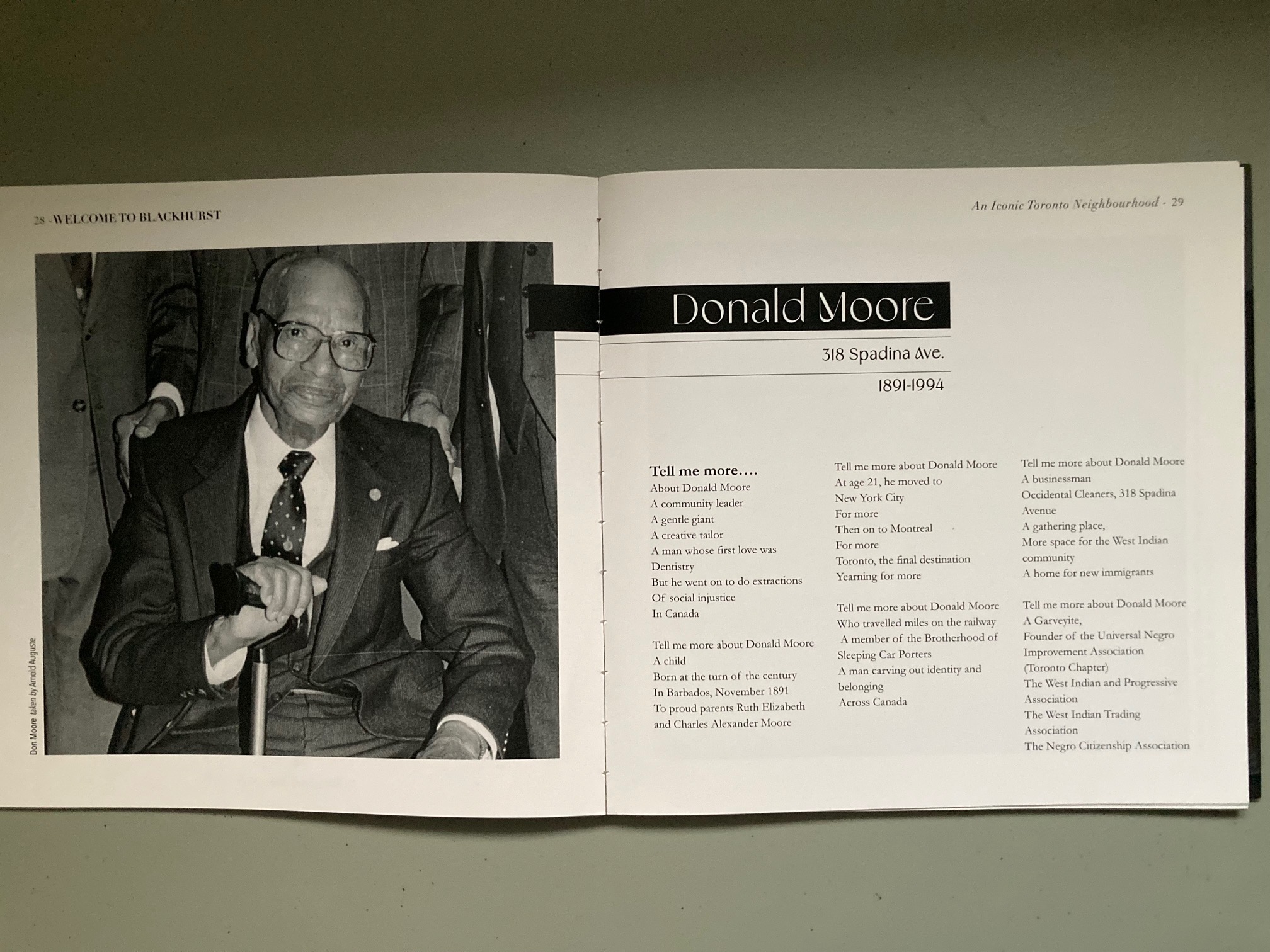
Donald Moore is featured in the book Welcome to Black: An Iconic Toronto Neighbourhood published by A Different Publisher in 2022


Sixty-nine years ago today, a delegation of 35 Black activists from the Negro Citizenship Association (NCA)—led by Barbados-born Donald Willard Moore, also known as Don Moore or “Uncle Don,” and Canada-born Stanley Grizzle—met in Ottawa with federal Cabinet members to challenge Canada’s anti-Black immigration policies.


On April 27, 1954, the delegation presented a brief to Walter E. Harris, minister of immigration and member of parliament for High Park. In the book, Towards Freedom: The African-Canadian Experience, Ken Alexander and Avis Glaze write: “The group’s presentation, thoroughly researched, articulate, and defiant, changed the course of Canadian history. Many of the delegates had been active for years. By helping thousands of blacks settle, find jobs, unionize workers, meet contacts, and avoid deportation, people like Moore, Grizzle, Harry Gairey, Lenore Richardson, and many others, were building the community from the ground up.”


In the memoir, A Black Man’s Toronto, 1914-1980: The Reminiscences of Harry Gairey, edited and with an introduction by Donna Hill—mother of author Lawrence Hill and singer-songwriter Dan Hill—Gairey recollects that the NCA was founded in February 1951 in Moore’s house on Dundas Street in Toronto with the chief aim to “try and break up this immigration problem, because I knew that it was discriminatory.” As a sleeping car porter working around Union Station, Gairey said he saw all of the immigrants coming in, “but no Blacks, not a trickle. I saw a number of immigrants from the countries that we’d been fighting, Italy, Germany, all over, the Europeans were coming in, no Black.


“The climax came when I went down to Jamaica after the war. I saw codfish from Newfoundland, from Halifax, canned goods like sardines and salmon from New Brunswick, Nova Scotia. The people in the West Indies had to buy all these Canadian goods. And still, they were not allowed to come into the country, to get some of that money so they could turn it back to their people.”


Gairey said he was responsible for getting a sleeping car for the 35 members of the delegation. Regarding the meeting with Minister Harris, he recollects that: “It was a small office, so he started apologizing you know, because there were so many of us. I said, “I wouldn’t worry about that because we just want to present this brief to you, and the injustices, and introduce the president.” Donna Hill wrote that brief to the Minister of Immigration and Norman Grizzle read the brief.”


Alexander and Glaze note that Stanley Grizzle summarized Canada’s immigration policy vis-à-vis blacks as a “Jim Crow Iron Curtain.” Quoting Moore from Donald Moore: An Autobiography, 1985, the authors wrote that he stated at the Ottawa meeting: “You kept them out because they are black. If I were a Communist, there is opportunity for me to change and become a decent, respectable Canadian citizen. But I am born black; God has made me that way. You are asking me to undo what God has done.”


Bromley: Tireless Champion for Just Causes. Memoirs of Bromley L. Armstrong written with Sheldon Taylor notes that the 35-member NCA delegation included various Black community organizations, labour, and mainstream religious denominations who were involved in further deliberations and strategy sessions while travelling by train to Ottawa. 


“Reading from the final draft of the NCA’s brief Moore requested that the St. Laurent government amend its understanding of “British subject” to include all British subjects and citizens of the United Kingdom and Commonwealth,” writes Armstrong.


It would take meetings with government officials from Barbados and Jamaica, and more than a year of lobbying before any opening up of Canada’s immigration occurred. A memo from Laval Fortier to the director of immigration, dated June 10, 1955, noted that the Cabinet had decided “to admit a certain number of domestics from the British West Indies on an experimental basis. 75 of these domestics to be to be selected from Jamaica and 25 from Barbados.” The memo also noted that, “these domestics are to be admitted as immigrants upon arrival.”


Armstrong noted that: “As members of the NCA we did not get all that we had wished for. Yet with the West Indian Domestic Scheme, a formalized arrangement between Ottawa and certain Caribbean nations, the doors were being inched open. In the process, Ottawa politicians and bureaucrats were sensitized in some small measure about the dangers of their racist immigration policies. The many tens of thousands of immigrants from the Caribbean now living in Canada are a testament to our efforts.”


Describing the delegation to Ottawa as “the first time in history that African Canadians had undertaken such a mission—to challenge the policies of the federal government,” Stanley Grizzle in his memoir, My Name’s Not George: The Story of the Brotherhood of Sleeping Car Porters in Canada, written with John Cooper, noted that he told Minister Harris that they were prepared to continue fighting “unremittingly for the right of all people of this planet to enter Canada and become its citizens without penalty or reward because of their race, colour, religion, national origin or ancestry.” Grizzle said NCA assured the minister that they had taken that stance based on the findings that Canada’s immigration laws against blacks were premeditated and discriminatory. “I presented statistics showing that immigration from “white” countries such as England far outstripped immigration from the West Indies, Japan and China. I pointed out that between 1871 and 1951 there was a constant increase in the population of the white European group and a decrease in the population of non-whites in Canada, a situation deemed “dangerous, strange and unfortunate”.”


In a speech titled “Reimagining Generational Wealth Beyond Biological Imperatives,” at an event organized by Kean Real Estate Group in Brampton, Ontario, in February this year, Dr. Karen Flynn, associate professor in the Department of Gender and Women's Studies, Center for African Studies, at the University of Illinois, Urbana-Champaign, who was the keynote speaker referenced the work of Moore, the community icon and trailblazer.


She said historically and in this contemporary moment, Black people have harnessed their social and cultural capital to ensure their survival. Social capital is defined as internal connections between people within the same group. Cultural capital refers to the symbols, ideas, tastes, and preferences that can be strategically used as resources to advance social action. Social and cultural capital is visible in the organizations Black Canadians and Caribbean people established to fill in the gap, noted Dr. Flynn. She cited the Coloured Women Club of Montreal (CWCM) and the Negro Citizenship Association as examples of such capital.


The CWCM was founded in 1902 to assist with the 1918 flu epidemic, kept a bed at Grace Dart Hospital, and cared for the homes and children of hospitalized parents. The club members volunteered as visiting nurses and nurses’ aides. Dr. Flynn, who is the author of the book Moving Beyond Borders: A History of Black Canadian and Caribbean Women in the Diaspora, noted that the CWCM also maintained a plot of land at the Mount Royal Cemetery for the interment of community members for those unable to afford the cost of burials.


She said the Negro Citizenship Association that Moore established in 1951 was a social and humanitarian organization. “The NCA fought relentlessly to challenge Canada’s racist immigration policies which the organization pointed out denied equal immigration status to non-white British subjects. Moore and the NCA along with delegates went to Ottawa to present a brief. To be clear, Moore was also advocating for citizens from India and Pakistan.”


Dr. Flynn said as a result of Moore and the NCA, Canada began to relax its immigration policies, which led to the West Indian Domestic scheme—an agreement between the government of Canada and various Caribbean islands. “These 100 domestic workers who came to Canada beginning in1955 from Barbados and Jamaica made it possible for our parents to be here. If you are interested in learning more about the West Indian Domestic scheme, check out the podcast, “Strong and Free,” or just do a search for Karen Flynn and Garvia Bailey.” 


Dr. Karen Flynn, associate professor in the Department of Gender and Women's Studies, Center for African Studies, at the University of Illinois, Urbana-Champaign, was the keynote speaker at an event organized by Mean Real Estate Group in Brampton, Ontario


In 1956, Moore and two other members of the Negro Citizenship Association purchased a 12-room house on Cecil Street in Toronto and converted it into a recreation centre for the West Indian community called Donavalon Centre.


Dr. Flynn pointed out that this was her first example of reimagining generational wealth beyond biological family members. “What if instead of a plaque, the Caribbean community still owned that center some 67 years later? We can imagine the possibilities.”


According to Armstrong, even in his sixties Moore professed a commitment to the radical politics of Marcus Garvey and the UNIA. In fact, the Toronto branch of that organization was founded in 1919 in Moore’s tailor shop when it was located on Spadina Avenue, he said.


In the book Welcome to Blackhurst: An Iconic Toronto Neighbourhood, there is a poem “Tell me more…” written by Itah Sadu about Moore in which she describes him as a community leader, a gentle giant, a man who after leaving Barbados lived in New York and then Montreal before moving to Toronto, his community advocacy and activism, and “a man who lived to the age of 102 with incredible vision and elevation for all Canadians….”

Saturday, 8 April 2023

Study About Prostate Cancer Among Caribbean and West African Immigrants Helps Men’s Group

 By Neil Armstrong


Photo contributed      Dr. Aisha K. Lofters, Chair in Implementation Science at the Peter Gilgan Centre for Women's Cancers, Women's College Hospital


A new study about the high incidence of prostate cancer among immigrants from Caribbean and West African countries in Ontario is helping a Black men’s health advocacy group to raise awareness about the cancer.


The population-based research led by Jamaican Dr. Aisha K Lofters, Dr. Jacqueline L. Bender and a team, including Anthony Henry, vice president, and Kenneth Noel, president of The Walnut Foundation, found that in Ontario the age-standardized incidence rate of prostate cancer from 2008 to 2016 was consistently and significantly higher among immigrants from those countries than among other immigrants and long-term residents of the province. 


“This data tells us what’s happening but it can’t tell us what the cause is; there have been several theories that people have put forth. One is that it’s something genetic. Ultimately, many men who come from the Caribbean — their ancestors came from West Africa — the same other region that we found, so is there something genetic that has to do with men who are West African that gives them a higher likelihood of developing prostate cancer?”


Dr. Lofters says people have theorised that it could be diet-related so caused by elements of the Caribbean and West African diet, or it could be environmental exposures. But she said the latter would be harder to explain when there are men living here who are coming from two very different parts of the world.


“Although we don’t know the reason I would suspect that there is some genetic or biological component that’s explaining it for men from these two particular areas. 


The physician, scientist, and associate professor at the University of Toronto says there are researchers who are trying to figure out if there are specific genes that can be targeted to help them identify this, but more work is needed to be able to hone in and determine who is at higher risk when talking about men coming from these regions. 


She also noted that family history is a risk factor for prostate cancer so it is very important for men to know their family history. 


Dr. Lofters, who is the Chair in Implementation Science at the Peter Gilgan Centre for Women's Cancers, Women's College Hospital, says when men are having symptoms such as a change in their stream, blood in their urine or unexplained weight loss they should not ignore these as they could be a red flag. She recommends going to see a doctor where blood tests or a rectal exam can be done to determine if something is happening with the prostate. 


The study has been published in the Canadian Medical Association Journal, presented at conferences and covered by the media to help raise awareness among men in the community, and for family doctors and primary care nurses to have their antennae raised when dealing with men from the Caribbean and West African countries with such symptoms to recognize that they might be a higher risk of prostate cancer.


The World Health Organization statistics of global prostate cancer mortality in 2020 indicate that Zimbabwe had the highest rate of prostate cancer mortality, followed by Barbados, and other Caribbean and African countries. Jamaica is ranked fifth on the list.


“What we find here in Ontario aligns with what the global statistics tell us about prostate cancer,” says Lofters, who alongside Dr. Bender, is working with The Walnut Foundation to understand the experiences of men diagnosed with prostate cancer in the healthcare system.


The organization, a men’s health interest and prostate support group, works with the Black community in identifying the needs of Black men in health and related issues. 


“We have heard stories of men being dismissed or not being provided the highest standards of care when it comes to prostate cancer so we really want to understand, are there systemic barriers in Canada’s healthcare system that could be improved upon for these men as they journey through the prostate cancer system? That’s one body of research that’s actively happening.”


The researchers also want to examine the Ontario data to see if there are differences in terms of stage of diagnosis.


While the study examined the incidence of men just developing prostate cancer, the researchers also want to know if there were particular men who were diagnosed later than others because early diagnosis is better. They also want to understand other differences, in terms of survival. This is upcoming research that they are working jointly on with The Walnut Foundation. 


Photo contributed     Anthony Henry, Vice President, The Walnut Foundation


Henry says the study helps to inform the Foundation, which is dealing with Black men who are impacted, and he underscored the importance of men doing their prostate-specific antigen (PSA) tests and digital exams earlier — at age 40, instead of 50.


“My father died from this thing at 68 so my brother and I started monitoring at 40. Luckily for us, we had medical practitioners who understood the issue and were in agreement to say, hey, you guys should start testing from then,” says Henry whose cancer was caught at age 54 and his brother’s at 57, just from monitoring.


He says if men are monitored early enough and prostate cancer is detected, they have a fighting chance. However, if they pretend that there is no issue or wait around until 50, they might be in for a rude awakening.


The membership of the Foundation is predominantly Caribbean so it will outreach to men from West African countries and also native-born Black men. 


The vice president says this study is only the first step and the Foundation can now approach policymakers and the medical establishment to act on its findings.  It is also an opportunity to start dialogues with community health centres that are dealing with Black patients. 


Henry expressed concern that the Ontario Health Insurance Plan (OHIP) does not cover the PSA test, which means most men will have to pay $40 for it. Some doctors may check off a box to indicate that a man has to get the PSA done and that it is covered because they are from a high-risk group. 


The Princess Margaret Hospital and The Walnut Foundation are collaborating on a genetics study, in partnership with some community health centres, that will examine samples from Black men who died to ascertain where there is any gene commonality. 


TAIBU Community Health Centre and the Foundation are also collaborating on a video project to educate the community. 


On June 3, the Foundation will have its ninth annual walkathon led by honorary Chair, Ivan Dawns, political director of the International Union of Painters, to tap into the Union Movement to spread awareness. A couple events will take place in March in partnership with the Jamaican Canadian Association to educate the community. 


Henry says Black men have asked the Foundation if there were any urologists from the Black community to whom they could be referred, but he could only think of one in the Greater Toronto Area — Dr. Emmanuel Abara who is based in Richmond Hill, Ontario. 


To address this, the organization has set aside $26,000 from last year’s walkathon to set up an endowment for medical students at the University of Toronto with the hope that some will choose urology and improve health outcomes for the Black community. 


We need this type of research, I think, that does not look at the entire population as being homogenous but recognizes that there might be different ethnic and racial groups that are at higher or lower risk of particular conditions,” says Dr. Lofters, a scientist at Women’s College Research Institute.


She says that will allow them to provide personalized medicine and the highest quality of care.


Thursday, 30 March 2023

Toronto Artist Dedicates Upcoming Performance to Jamaican Dance Pioneer Barbara Requa

By Neil Armstrong


Photo credit: Michael Mortley    Kevin A. Ormsby in Christopher Walker's "Unmasked: Seaweed King"


Kevin A. Ormsby was in rehearsal at the University of Wisconsin-Madison in February in Christopher Walker’s “Unmasked: Seaweed King” when Walker got the news about the passing of Jamaican dance pioneer, icon, choreographer, and educator Barbara Requa and attempted to withhold the information from him until after the rehearsal.

Walker soon relented because both were devastated by the passing of such a seminal figure in dance; both were significantly influenced by Requa in their nascent dance career.  

“She gave me my first scholarship in dance. Without her I would not have been at Edna Manley School in the youth division program. I wouldn’t have started my formal training when I did,” says the Toronto dancer, choreographer and founder of KasheDance, noting that Requa was the principal then. 

Requa taught Walker when he was a student at Edna Manley College in the dance program; Ormsby was in the junior program. “She was definitely instrumental in providing that first access to formal dance training through the youth program,” says Ormsby.

The nationally recognized dancer and Arts advocate was so inspired by Requa that he decided after that rehearsal to dedicate his upcoming three-day performance to her.

Requa, a co-founder of the Edna Manley School of Dance and a former teacher, principal and dean, and a founding member of the National Dance Theatre Company, died on February 23 at the age of 90 in Mexico.  A thanksgiving service was held on March 20 in Jamaica. 

From April 13 to 15, Ormsby will present his much anticipated bi-national solo project, “Trilogy of Being…”, at The Citadel: Ross Centre for Dance. The three solos celebrate his dance career in Canada and the United States. 

This year marks 37 years in dance for the 2021 finalist of the Johanna Metcalf Arts Prize which celebrates artists in Ontario who have made a recognized impact on the field and the public, and show great promise in the ongoing pursuit of their ambitious and visionary practices.

“Trilogy of BEing…” is a creative collaboration between Canadian and American choreographers — all of whom had worked or danced with Ormsby throughout his career. The production is grounded in Black existence and experiences: environmental, social and cultural.  


Photo contributed   Kevin A. Ormsby


Christopher Walker’s “Unmasked: Seaweed King” depicts a sort of phoenix rising from the refuse / ashes; addressing human impact on the environment told through a character of ancient wisdom linking Afro-Caribbean mas performance traditions. It is a part of “The Kula Ring, A Gifting Economy” (2016), a transdisciplinary expedition project merging scientific, environmental, and artistic research around ocean conservation and climate change.

“Somebody” by Denise Fujiwara, was inspired by Ormsby’s call to action in the wake of George Floyd’s murder. “I suggested a collaborative creative process that resulted in the solo for him.”  Poetry by Giller Prize-winning Canadian author Ian Williams, Poet Laureate of Jamaica 2021-2024, Olive Senior, and Lambda Literary Award winner, American Rosamund S. King shapes the solo rich in contemporary butoh technique. 


Photo by John Hart Wisconsin State Journal  Kevin A. Ormsby in Joel Valentin-Martinez's "Dear Brother"


Joel Valentin-Martinez, through visual research of images and music of significant Black historical periods (Harlem Renaissance, 1960s -1970s, and the era of 80s hip-hop), crafts the solo, “Dear Brother,”  commenting on how we see contemporary Black and Brown lives in shaping music, fashion and popular culture. Friday’s performance of the piece includes a special presentation with three other dance artists (Will Brown (NYC), Benjamin Russell (Toronto), and Kevin Shawn (Calgary


“Trilogy of BEing…” starts at 8:00 p.m. on all three nights at The Citadel: Ross Centre for Dance which is at 304 Parliament Street in Toronto. Tickets are $35 but for Livestream the cost is $10.

https://www.eventbrite.ca/e/trilogy-of-being-tickets-404767559667


Sunday, 26 March 2023

Remembering Michelle Evans, A Daughter of Spanish Town Years Later

 By Neil Armstrong


Photo of Michelle Evans contributed by Donald Radcliffe


In high school is where most of us developed friendships that we hoped would last for a lifetime. While we were in different classrooms from first to fifth forms, it was in sixth form that those of us who chose that path all came together in our final two years of school — Arts or Science. That’s how it was at St. Jago High School in Spanish Town, Jamaica, where I met Michelle. Her surname was Easy then, but she subsequently changed it to Evans here in the Greater Toronto Area where she lived for many years. 


Michelle Evans, born on January 12, 1969, passed away here in the Greater Toronto Area on October 17, 2014, after a period of illness. It was only a few days ago that many of us — her high school friends living here in Canada, and in Jamaica — found out that she died more than eight years ago. We are in shock. How could she have died and there was no word of her death through our network or grapevine?


Since hearing of her passing, I have contacted mutual high school friends, and even members of my family who met Michelle, to share the news with them. Thank you, Rodcliff Lewis, for listening to that inner voice that propelled you to visit her family home on Ellis Street in Spanish Town to ask about her. Thanks to Antoinette “Shaggy” Cole-McFarlane for being the conduit of Rodcliff’s updates regarding Michelle.


Michelle was outspoken and could argue eloquently with much laughter to share. That’s my memory of her in high school and even in our conversations here. In the lead up to exams, we — including Charmaine Simpson, now deceased; Opal Wright, and Carolyn DaCosta — would head to the Kingston and St. Andrew Parish Library or the Institute of Jamaica to study. Michelle was the co-editor of Ravensworth Review, the 1985-1986 school yearbook from which I have pulled some of the photos to share in this reflection of/tribute to her. She helped me to organize a class party at my home when we were in lower sixth form. Michelle was a conscientious person. 


Although she migrated to Canada several years before I did, when we reconnected it was seamless — there were no gaps in our friendship. Michelle would often accompany me to weekend events when I worked at a radio station at York University. We would check out some cultural events, restaurants, and just chat. It was Michelle who informed me of the passing of fellow schoolmates Charmaine Simpson (July 5, 2000) and Albert Coombs (December 24, 2008). We — Michelle, Donald Radcliffe, and I — kept in touch but at some point our tight connection loosened. Life is like that; sometimes we are so focused on obligations, responsibilities, and priorities that we grow apart.


I hadn’t spoken to Michelle in years but I remember meeting her daughter, Avarie, and how much of a doting mother she was to her. Michelle had changed her job, moved to somewhere else in the city, and soon we lost our bond of friendship.


Pages of Ravensworth Review, St. Jago High School, 1985-1986, for which Michelle was the co-editor


Although it is more than eight years later, I would like to express my condolences to Avarie, Michelle’s mother, Edith, sisters Elleith and Valerie, and other family members. 


Michelle, a daughter of Ravensworth, Spanish Town, has left us but she will never be forgotten.


Hanging out with Michelle at an event in Toronto, Canada


Saturday, 11 March 2023

David Blake named inaugural academy director of Urdang at City

David Blake named inaugural academy director of Urdang at City: TORONTO: When a guest at a hotel on Jamaica’s north coast predicted that young David Blake would become a star, little did his mother know that not only would he become a principal performer in the Disney musical, The Lion King, at the Lyceum...

Black Scientist’s Task Force Proposes Anti-Black Racism Strategy To Ontario Government

Black Scientist’s Task Force Proposes Anti-Black Racism Strategy To Ontario Government: By Neil ArmstrongContributing Editor TORONTO, Ontario (Friday, February 17, 2023) — An eminent group of Black scientists in Ontario has proposed that the provincial government adopt its vision of “an evidence-informed public system approach that supports the equitable health, wellbeing and prosperity of Ontario’s Black population.” The Black Scientists’ Task Force on Vaccine Equity, which ...